 BestTime
The least crowded time to visit most museums and attractions is right after opening on a weekday, or the last hour before closing. Midday and weekend afternoons are the busiest. To check a specific place, open BestTime's free city guide for sightseeing, museums or parks and nature, which show how busy each venue usually is for every hour of the week.
This guide shows the typical patterns, how to read a venue's forecast, how to plan a full sightseeing day around quiet hours, and how tour operators and travel apps use the same data.
When are museums and attractions least crowded?
Most museums, landmarks and parks follow the same shape:
- First hour after opening. Crowds build through the morning. Arrive at opening and you often have the main rooms almost to yourself.
- Late afternoon on weekdays. After about 4 PM many tour groups and school visits have left.
- Weekdays over weekends. Monday to Thursday are usually quieter than Friday to Sunday.
- Midday is the peak. From late morning to mid-afternoon most attractions are at their busiest.
- Late opening nights are mixed. Some museums are calm on late evenings; others draw a big after-work crowd. Check the forecast.
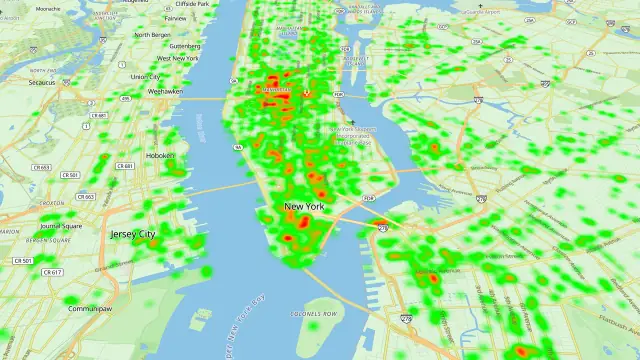
The aggregate pattern for New York City shows this clearly. The heatmap below combines the forecasts for 156 sightseeing spots across the city.
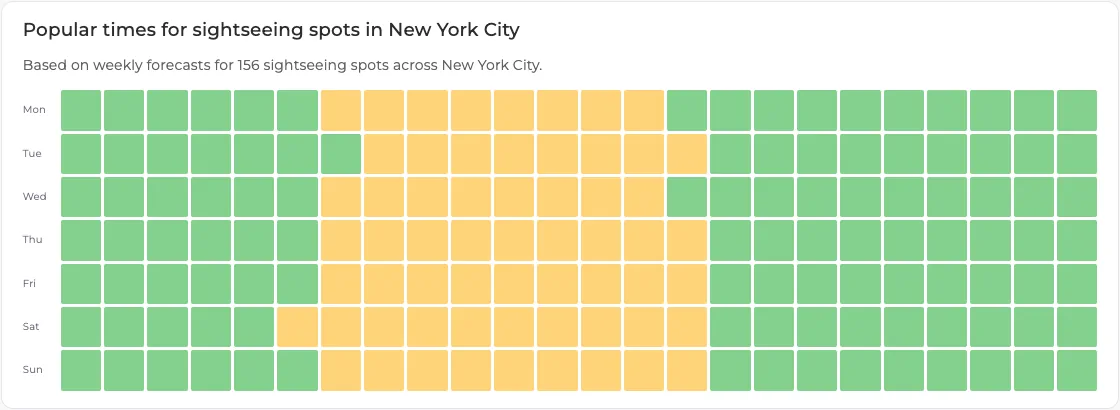 Sightseeing spots in New York City combined: green mornings and evenings, busier from midday to early evening on every day of the week.
Check the forecast for a specific place
The free city guides list attractions per city with a week heatmap for each one. To use them:
- Open the guide for your city and category, for example sightseeing in New York City. Other categories are
museumandnature. - Set the day you plan to visit.
- Set the time: morning (6 AM to 12 PM), afternoon (12 PM to 6 PM) or evening (6 PM to 11 PM).
- Set busy to quiet to show only places forecast under 30% of their weekly peak at that time.
For example, quiet museums in New York City on Tuesday morning.
Each card shows a heatmap with one row per day and one column per hour. Green means not busy, yellow means a little busy, and red means as busy as it gets. Many cards also show how long visitors usually stay, which helps you plan how much time to set aside.
Example: Central Park
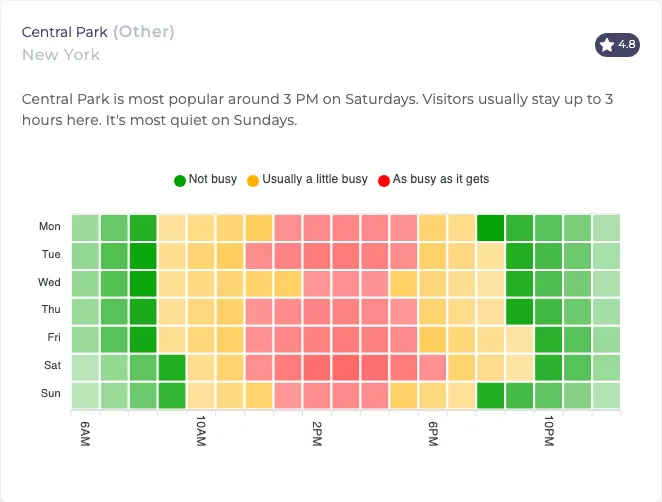 Central Park: most popular around 3 PM on Saturdays, quietest on Sundays, and visitors usually stay up to 3 hours.
Central Park is green in the early morning, turns yellow from about 9 AM and is red from around noon to 5 PM on most days. The busiest hour is around 3 PM on Saturday. If you want a quiet walk or an early picnic spot, go before 9 AM. For a picnic in the afternoon, Sunday is the calmer weekend day, and the park thins out again after about 7 PM.
Example: the Colosseum
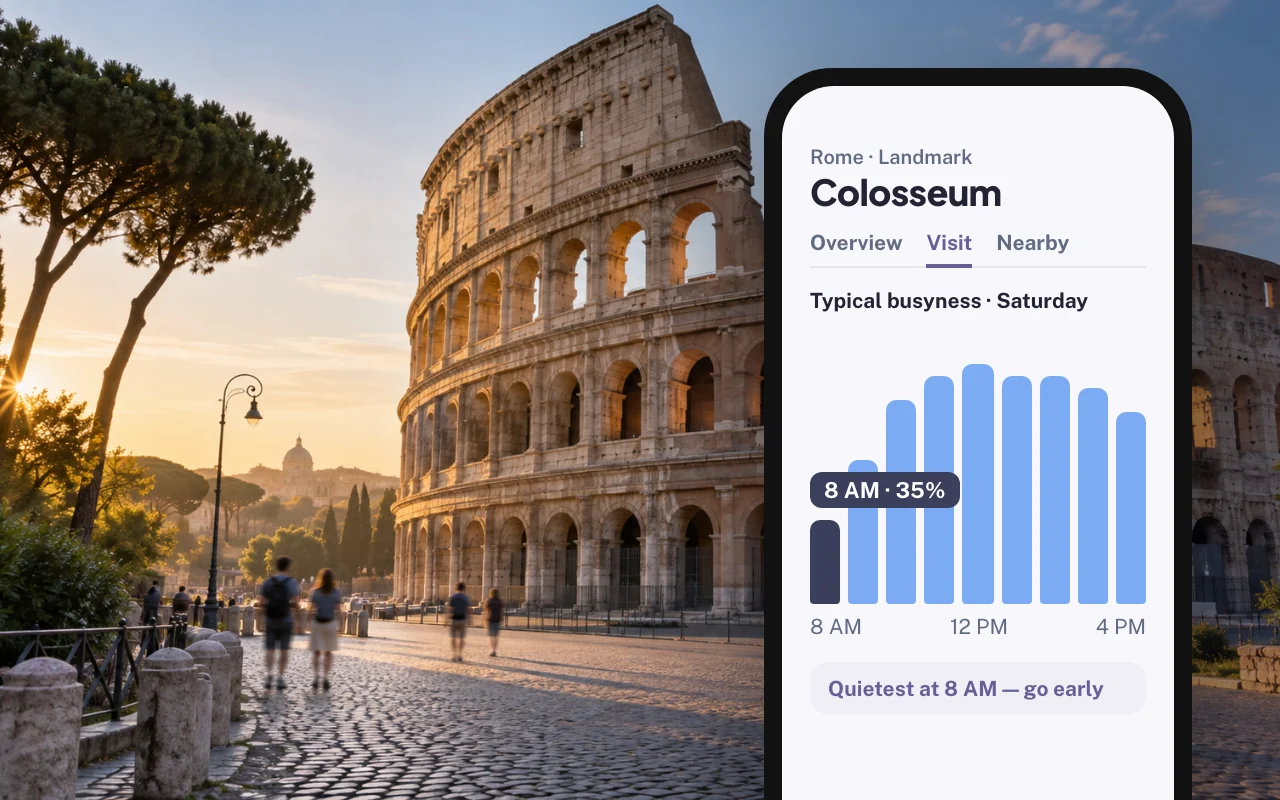
The same works outside New York. The Colosseum in Rome is at about 35% of its peak at 8 AM on a Saturday and builds to its busiest hour around noon. If you go at opening, it is about a third as busy as at midday.
Plan a sightseeing day around quiet hours
If you visit several places in one day, order them by their quiet hours instead of by the map.
- List the places you want to see and open each one's heatmap for the day of your visit.
- Put the busiest attraction first. The one with the strongest midday peak is the one to visit at opening.
- Fill the middle of the day with places that stay calm, such as smaller museums, walking routes or a neighborhood without big landmarks.
- Go outdoors when indoor spots peak. Parks and viewpoints are often a better fit for midday than galleries.
- Save a late slot for an attraction that quiets down after 4 PM, or one with a late opening night.
- Check dwell times so you do not plan a quick stop at a place where people usually stay for hours.
For beaches and parks on a hot weekend, the same rule applies: early morning is calm, early afternoon is the peak, and the crowd thins in the evening.
For tour operators and travel apps
If you run tours or build a travel app, the forecasts help you:
- Schedule group tours at quiet hours, so guests spend less time in lines and more time inside.
- Suggest the best time to visit on every attraction page in a city guide or itinerary app.
- Recommend alternatives when a landmark is at its peak, such as a nearby museum that is quiet at that hour.
- Build itineraries automatically by ordering stops by their forecast busyness.
The BestTime API gives you the hourly forecast for any public venue. A new forecast by name and address costs 2 credits, and a refresh or query by venue ID costs 1 credit. The Venue Filter returns venues in an area that match a day, an hour range and a busyness range, such as museums under 30% on Tuesday morning. Start with the Venue Filter API tutorial or the API documentation. You can sign up for a free test account without a credit card.
What the forecast can and cannot tell you
BestTime forecasts how busy a venue is for each hour of the week on a 0-100 scale. The forecasts are built from anonymized, aggregated phone location data combined with other real-world signals such as weather, events and holidays.
- 100 is the venue's own busiest hour of the week. A small gallery at 100 can be less crowded than a major museum at 50.
- It is not a head count. BestTime does not return visitor numbers or ticket availability.
- It describes a typical week. A new blockbuster exhibition, a free admission day or a parade can make one day busier than usual. Timed-entry tickets can also flatten the peaks inside a museum while the lines outside stay long.
Next steps
- See the busiest and quietest times for New York bars and restaurants in NYC nightlife and restaurant busy times.
- Add best time to visit data to a travel site in enhance city guides and venue recommendation websites.
- Learn how the 0-100 scale works in forecast venue busyness.
Questions
What is the least crowded time to visit a museum?
For most museums it is right after opening on a weekday, or the last hour or two before closing. Midday and weekend afternoons are usually the busiest. Check the forecast for the museum itself, because some peak earlier or later.
Which day of the week is best for visiting popular attractions?
Weekdays from Monday to Thursday are usually quieter than Friday to Sunday. Some attractions have their own quiet day, so look at the week heatmap for the place you plan to visit.
How can I see how busy a museum or park will be?
Open the free BestTime city guide for sightseeing, museums or nature in your city. Each venue has a week heatmap that shows how busy it usually is for every hour of every day.
Does the busyness forecast include special exhibitions and events?
The forecast describes a typical week. A new exhibition, a free admission day or a big event can make a single day busier than the forecast.
BestTime in 47 seconds
See how busy any place gets, hour by hour
BestTime forecasts how busy a venue gets for every hour of the week, from anonymized, aggregated phone location data combined with weather, events and holidays. Look up one venue, compare a whole city, or use the API.
Try BestTime for free
Create a free account without a credit card, forecast a few venues you know, and see their busy and quiet hours for every day of the week.
Start free See pricing